
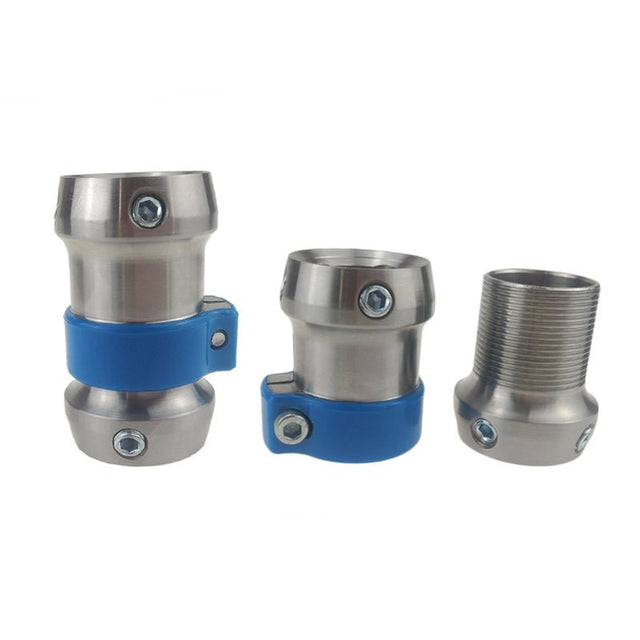
Prosthetic lower limb adapters are essential components that connect different parts of a prosthesis—such as the socket, pylons, knee joints, and feet—into a unified, functional system. They play a crucial role in achieving proper alignment, stability, and adjustability, ensuring that each prosthesis is tailored to the unique biomechanics and lifestyle of its user.
Key Functions of Adapters
-
Structural Connection – Securely link prosthetic components together.
-
Alignment Adjustment – Allow clinicians to fine-tune angles and positioning for optimal gait.
-
Versatility – Enable compatibility between modular components from different systems.
-
Durability – Provide robust support for daily activity and load-bearing.
Types of Prosthetic Adapters
-
Pyramid Adapters
-
Among the most common types.
-
Provide multi-directional alignment (anterior-posterior, medial-lateral, and angular adjustments).
-
Often used between sockets, pylons, and prosthetic feet.
-
-
Pylon/Tube Clamps
-
Allow secure connection of prosthetic tubes (pylons) with adjustability.
-
Enable easy length modification and angular alignment.
-
-
Rotary/Rotational Adapters
-
Permit controlled rotational movement of the limb, improving comfort for activities like sitting cross-legged or dressing.
-
-
Torsion Adapters
-
Absorb and release twisting forces during walking or sports.
-
Enhance shock absorption and reduce stress on the residual limb.
-
-
Shock-Absorbing Adapters
-
Incorporate cushioning elements (springs or elastomers).
-
Reduce impact on joints during high-activity use, protecting both user and prosthesis.
-
-
Offset Adapters
-
Shift component alignment medially, laterally, anteriorly, or posteriorly.
-
Useful for accommodating unique residual limb shapes or socket positions.
-
-
Angled/Swivel Adapters
-
Allow specific angular positioning or pivoting functions.
-
Support improved comfort and gait correction.
-
-
Knee and Foot-Specific Adapters
-
Designed to connect sockets to knee joints or feet with precise alignment features.
-
Ensure smooth integration of complex prosthetic systems.
-
Conclusion
Prosthetic lower limb adapters are the linking and alignment backbone of modular prostheses. With a wide variety of types—from pyramid adapters to torsion and shock-absorbing connectors—they provide clinicians the flexibility to create highly individualized, comfortable, and performance-oriented prosthetic solutions for each user.


