
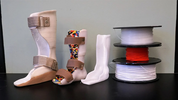
Why FDM 3D Printing Shouldn’t Be Used for AFOs
, by Hugh Sheridan, 5 min reading time
, by Hugh Sheridan, 5 min reading time
Over the past decade, 3D printing has opened exciting new opportunities in orthotics. Faster prototyping, lighter devices, digital design, and customizable shapes have made additive manufacturing part of many modern workshops.
But not all 3D printing methods are equal — and when it comes to ankle-foot orthoses (AFOs), especially for pediatric patients, one message is becoming clear:
FDM printing is not the right technology.
Here’s why.
Fused Deposition Modeling (FDM) melts plastic filament and lays it down layer by layer. It is:
affordable
widely available
easy to learn
useful for jigs, test parts, and workshop accessories
For general prototyping, FDM is fantastic. But AFOs are medical devices that must tolerate real-world biomechanical loads, sweat, heat, twisting, and repetitive impact.
This is where problems start.
Because FDM builds parts in stacked layers, the material doesn’t fuse homogeneously. Instead, seams form between layers.
For a brace exposed to constant bending and torsion:
cracks start at the layer lines
micro-fractures propagate over time
failure often occurs suddenly — not gradually
Children run, jump, climb, kneel, and test limits. An AFO that fails mid-activity risks:
falls and injuries
ankle/foot trauma
loss of confidence and device rejection
A device designed to stabilize shouldn’t become a source of risk.
Many common FDM materials (PLA, PETG, ABS) react poorly to daily life:
soften in heat (cars, playgrounds, Middle Eastern climates)
absorb sweat and odors
become brittle under UV exposure
In real clinical use, this means:
deformation around trim lines
reduced alignment accuracy
earlier breakage
hygiene challenges for parents
Children don’t treat orthoses gently — nor should they have to.
Good AFO outcomes depend on controlled stiffness, smooth transitions, and carefully placed reinforcements.
With FDM, stiffness varies depending on:
print direction
infill pattern
nozzle temperature
user settings
Two “identical” devices can behave differently — something unacceptable in clinical care, documentation, or follow-up adjustment.
Predictable biomechanics require:
isotropic (or near-isotropic) material properties
validated, repeatable production methods
FDM cannot reliably deliver this.
Across many regions, regulators and professional bodies are increasingly cautious about FDM AFOs because:
material test data rarely matches real clinical environments
traceability and QA are difficult
long-term fatigue performance is weak
Children change quickly — gait, body mass, alignment — and devices need to be safe over time, not just on fitting day.
Additive manufacturing still plays an important role.
Technologies such as:
Powder is fused into a solid, near-isotropic structure — stronger and more uniform.
Similar to SLS, but with improved surface finish and durability.
These allow:
controlled stiffness tuning
validated materials (e.g., PA11/PA12)
safer fatigue behavior
cleaner interior surfaces for hygiene
Combined with solid design protocols and QA, these processes can be appropriate for certain AFO applications.
For pediatric orthoses, priorities must be:
FDM simply doesn’t meet these requirements for AFOs — especially for growing, active children.
It still has value in the orthotic workshop — for fixtures, temporary tools, educational models, and non-load-bearing braces (Spinal, Cosmetic Covers, etc) — but not for definitive clinical braces intended to support movement and protect joints.
Digital workflows are not about “printing cheaper.”
They are about delivering safer, smarter, more consistent care.
Choosing the right technology — and knowing when not to use one — is part of responsible innovation.

The global 3D printing market has changed dramatically in the last decade. Once dominated by a handful of Western manufacturers, it is now shaped by...

As digital workflows continue to reshape orthotic practice, Supramalleolar Orthoses (SMOs) have become one of the clearest case studies for comparing traditional fabrication with additive manufacturing....

Over the past decade, 3D printing has opened exciting new opportunities in orthotics. Faster prototyping, lighter devices, digital design, and customizable shapes have made additive...