
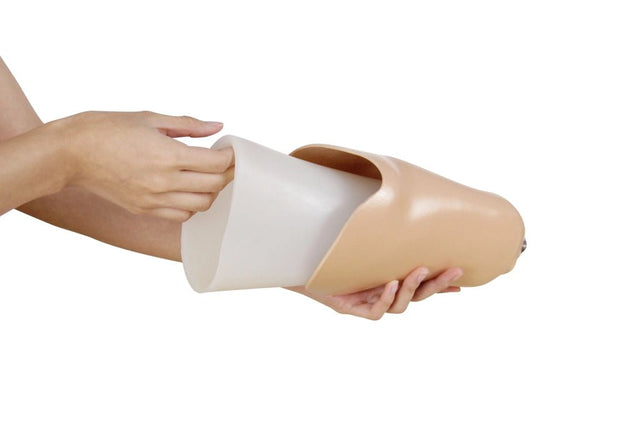
The prosthetic socket is the critical interface between an amputee’s residual limb and their prosthesis. Modern socket technologies combine advanced materials and suspension systems to improve comfort, stability, and mobility, enabling users to achieve higher levels of function and independence.
Liners
Liners act as a soft interface inside the socket, providing cushioning, reducing shear forces, and enhancing skin protection. Common liner materials include silicone, urethane, and thermoplastic elastomers (TPE), each offering unique advantages in terms of comfort, durability, and pressure distribution.
Suspension Systems
Suspension ensures the prosthesis stays securely attached during movement. Options range from suction suspension for a secure seal, to pin-lock (shuttle lock) systems for reliable mechanical attachment, to elevated vacuum systems that actively draw out air, maintaining consistent fit and reducing pistoning.
Vacuum Systems
Vacuum-assisted suspension technology uses mechanical or electronic pumps to maintain negative pressure between the liner and socket. This system improves circulation, minimizes volume fluctuations in the residual limb, and provides a stable, intimate fit—supporting more natural movement and reducing long-term skin problems.
Shuttle Locks
Shuttle lock systems employ a pin at the distal end of the liner that locks into the socket, offering a simple, secure, and widely used suspension method. They provide amputees with confidence in daily activities, are easy to use, and remain one of the most common solutions for below-knee prostheses.
Why Socket Technologies Matter
Prosthetic socket technologies are at the heart of successful rehabilitation. By combining advanced liners, secure suspension, and innovative systems such as vacuum-assisted fit or shuttle locks, today’s sockets maximize comfort, reduce skin complications, and allow amputees to live more active, independent lives.


