
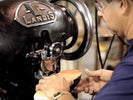
Landis International: A workshop equipment legacy
, by Hugh Sheridan, 5 min reading time
, by Hugh Sheridan, 5 min reading time
Landis International represents a core truth of O&P manufacturing: the workshop is still the engine room. Digital tools expand what’s possible—but traditional fabrication equipment protects quality, safety, and repeatability. The future isn’t “traditional vs digital.”It’s traditional + digital, engineered as one workflow.
When people talk about “digital transformation” in orthotics and prosthetics, the conversation often jumps straight to scanners, CAD libraries, and 3D printers. But in every real workshop—whether you’re vacuum-forming AFOs, finishing a socket, or grinding an orthopedic shoe—the unsung heroes are still the machines that shape, refine, and finish the work.
One of the most recognizable names in that world is Landis International.
Landis International is a Canadian manufacturer and distributor of orthotics and shoe-repair equipment, long established as a major North American supplier for the trades. The company is an industry leader and key supply source, offering new and refurbished machines, plus tools and spare parts designed to keep workshop equipment running for the long haul.
Landis emphasizes two themes that explain why its brand became so embedded in O&P labs:
A prosthetic/orthotic workshop is hard on equipment: dust, vibration, heat, adhesives, grinding media, and daily heavy use. Landis positions its ecosystem around durability, serviceability, and parts support—the kind of reliability that matters when your production schedule can’t stop because a motor or spindle is down.
Landis sits at the intersection of cordonnerie (shoe repair) and orthopedic fabrication—a crossover that makes perfect sense because foot orthotics and orthopedic footwear demand the same core finishing processes: sanding, grinding, buffing/polishing, and edge work.
A good example is the Landis S-500 type of finisher/shoe machine format—described as specifically designed for orthopedic shoe and foot orthotic production, with practical workshop advantages like dual-belt work areas and integrated dust collection.
Landis has more than 50 years of experience and highlights increased international presence, plus R&D capacity to adapt products to changing technology realities. That’s an important point: the best workshops don’t “replace” traditional fabrication—they upgrade it.
Digital workflows are powerful—but patients don’t wear STL files. They wear devices that must be safe, comfortable, durable, and cleanly finished.
Here’s what “traditional” equipment still delivers that digital can’t replace:
Smooth edges, controlled contours, consistent wall thickness transitions
Better cosmetic finish and reduced skin irritation risk
A more repeatable “feel” and function across refits and follow-ups
A well-equipped finishing line (sanders/finishers/extractors) reduces handwork time, prevents bottlenecks, and supports multiple technicians working in parallel (a key point in dual-workstation formats).
Dust and particulates in O&P are not a minor issue—especially when you’re grinding plastics, composites, and foams. Equipment designed around dust extraction and safer workstation layouts is an investment in:
technician health
fewer sick days
better retention
lower long-term operational risk
Digital isn’t “nice to have” anymore. In 2026, it’s becoming the workshop language of:
repeatability
scalable service
remote collaboration
documentation and traceability
Digital investments (scanning, CAD, CAM/printing, and workflow software) pay back through:
faster iteration (especially for AFO/SMO/insoles and check sockets)
standardization across sites (critical for multi-branch clinics)
better recordkeeping (supporting audits, tenders, and payer requirements)
The best O&P labs don’t choose sides. They build a hybrid production chain:
Scan → CAD → Print/CNC → Assemble → Finish → Fit → Iterate
And that last mile—finish + fit—is where workshop equipment brands like Landis remain essential. Even a beautifully printed part often needs:
trimming
deburring
smoothing contact surfaces
alignment touch-ups
cosmetic finishing
Digital makes you faster. Traditional equipment makes you wearable.
If you’re budgeting CAPEX, think in three buckets:
Safety & infrastructure first
Dust extraction, finishers, grinders, benches—reduce risk and unlock productivity.
Digitize the “repeatable” devices first
Foot orthoses, AFO/SMO classes, check sockets, covers—where iteration speed matters most.
Integrate, don’t scatter
Buy tech that connects: consistent file naming, patient records, standard work instructions, and predictable finishing steps.
Landis International represents a core truth of O&P manufacturing: the workshop is still the engine room. Digital tools expand what’s possible—but traditional fabrication equipment protects quality, safety, and repeatability.
The future isn’t “traditional vs digital.”
It’s traditional + digital, engineered as one workflow.

Digital orthotics can dramatically reduce the hidden costs of manual grinding, including technician time, material waste, inconsistent output and limited production capacity. This article explores...

The rise of smartphone scanning and 3D printing for custom insoles poses challenges for O&P clinics, highlighting the need for modernization in patient care.

Explore the balance between digital innovation and manual skills in prosthetics and orthotics,