
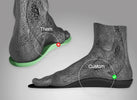
Smartphone Scanning and Retail Custom Insoles: Why Direct-to-Consumer 3D Printing Is a Warning Sign for O&P Clinics
, by Hugh Sheridan, 7 min reading time
, by Hugh Sheridan, 7 min reading time
The rise of smartphone scanning and 3D printing for custom insoles poses challenges for O&P clinics, highlighting the need for modernization in patient care.
Two recent 3D Printing Industry reports point to a significant shift in the custom insole market: retail brands are no longer simply selling off-the-shelf comfort products. They are moving into scan-based, personalised, 3D printed foot orthoses — and they are doing it directly through the consumer’s phone.
Superfeet has expanded its ME3D platform so consumers can generate personalised 3D printed insoles using an iPhone scan from home. The process removes the need for specialist scanning equipment or a clinic visit, while still presenting the product as individually engineered around the user’s foot geometry, arch profile, body mass and activity preference.
Kila, meanwhile, has launched Version 2.0 of its custom running insoles, using iPhone FaceID scanning, 3D printing and a proprietary NanoPEBA material positioned around energy return, lightweight performance and elite running. The company is not selling these as generic comfort inserts. It is presenting them as podiatry-grade, performance-focused custom orthotics for runners.
Together, these developments should be taken seriously by orthotists, prosthetists, podiatrists and orthotic laboratories. They show how quickly the language of clinical customisation is being absorbed by consumer retail.
For years, clinical providers could argue that custom insoles required specialist capture, assessment, prescription and fabrication. That remains true for medically indicated orthoses. However, the consumer market is now collapsing several steps of the traditional pathway into a digital retail workflow:
Superfeet’s ME3D model allows consumers to scan their feet using an iPhone, choose between foam options and order insoles that are delivered directly to their address. Kila uses a similar smartphone scan-to-order approach, with custom running insoles manufactured in San Diego and shipped globally.
This does not mean these products replace clinical orthoses for complex pathology. But it does mean the consumer’s expectation of “custom” is changing rapidly. A patient who can scan at home, see a 3D model and receive a personalised product within days may begin to question why a clinic pathway feels slower, less digital or less transparent.
The threat is not that every retail insole will outperform a clinically prescribed orthosis. The real threat is commercial, perceptual and behavioural.
Retail brands are making customisation feel easy. They are using clear digital journeys, simple pricing, performance language and direct delivery. By contrast, many clinical orthotic services still rely on opaque pricing, manual appointments, unclear timelines and limited digital engagement.
For private O&P clinics and podiatry providers, the danger is that low-complexity custom insole cases may migrate away from the clinic before the patient ever receives a professional assessment. Runners, gym users, walkers, people with mild discomfort, people with flat feet, and consumers seeking “performance support” may increasingly start with the phone rather than the clinician.
That matters because these entry-level cases are often an important part of a clinic’s commercial mix. They introduce patients to professional foot assessment, help clinics build long-term relationships, and create opportunities to identify more serious biomechanical, diabetic, neurological or musculoskeletal issues.
If the first point of contact becomes a retail app, clinicians risk losing both revenue and early clinical visibility.
Kila’s marketing is especially notable because it does not avoid the word orthotics. It uses terms such as custom orthotic insoles, podiatry-grade support, less pain, impact redistribution, faster recovery and performance gains. Superfeet similarly emphasises personalised support, custom arch profiles and 3D printed structures matched to each foot.
This is important because retail brands are no longer competing only on cushioning or comfort. They are competing on the perceived clinical value of custom design.
The more these terms become normal in consumer retail, the more difficult it becomes for clinics to justify their value simply by saying “ours are custom.” Custom is no longer enough. Clinical providers must explain what kind of customisation they provide, why assessment matters, how prescription differs from algorithmic personalisation, and when a medical-grade orthosis is required.
The clinical sector should not respond with panic or defensiveness. Smartphone scanning and 3D printing are powerful tools, but they do not replace clinical reasoning.
A scan can capture geometry. It cannot fully diagnose the cause of pain, assess neurological control, evaluate diabetic risk, interpret gait compensation, identify limb-length discrepancy, examine footwear interaction, or judge whether an insole is appropriate in the context of knee, hip, back or systemic pathology.
A direct-to-consumer insole may be suitable for performance comfort or mild support. But patients with diabetes, neuropathy, ulcer risk, severe pronation, paediatric deformity, post-surgical needs, inflammatory arthritis, neurological conditions, Charcot changes or complex pain presentations require professional assessment.
This distinction must be communicated clearly. The clinical profession should not argue that all retail custom insoles are poor. Instead, it should argue that medical orthotic care is more than shape matching.
The biggest risk is not that Superfeet or Kila will replace orthotists. The bigger risk is that they will own the consumer relationship earlier.
Retail companies are building digital pathways that educate, capture data, personalise products, re-market, offer multiple pairs and create repeat purchases. They are also gathering valuable foot geometry and preference data at scale.
Many O&P clinics, by comparison, still have limited online ordering, limited digital scanning visibility, minimal patient-facing education and weak follow-up systems. If clinics do not modernise their patient journey, they may retain only the complex medical cases while losing the larger wellness, sports and early-intervention market to retail brands.
That would narrow the role of the clinic and reduce its commercial resilience.
Clinics should not ignore this trend. They should respond by strengthening the parts of care that retail cannot easily replicate while adopting the digital tools that consumers now expect.
First, clinics need to make the value of assessment visible. Every custom insole consultation should clearly explain the difference between foot shape, pressure, gait, pathology, footwear, activity demands and clinical prescription.
Second, clinics should invest in digital capture where appropriate. Smartphone scanning, 3D foot scanning, pressure analysis and CAD/CAM workflows should not be seen as threats. They are tools that can help clinicians deliver faster, more consistent and more engaging services.
Third, clinics should create tiered orthotic offerings. Not every patient needs a complex medical device. A modern clinic can offer prefabricated, semi-custom, digitally customised and fully prescribed orthoses, with clear indications and pricing for each.
Fourth, professional providers should improve turnaround and communication. If retail can promise a scan-to-delivery journey in days, clinics must be able to explain why their timeline is clinically justified — or reduce it where it is not.
Finally, clinics should claim the health space more confidently. Retail brands can own convenience and performance. Clinicians must own risk assessment, diagnosis, pathology, long-term outcomes and multidisciplinary care.
The rise of smartphone-scanned 3D printed insoles is not the end of clinical orthotics. But it is a warning.
Superfeet and Kila show that consumer brands are moving quickly into territory that used to feel protected by clinical expertise, equipment and fabrication complexity. They are making custom insoles easier to buy, easier to understand and easier to repeat.
For orthotists, prosthetists, podiatrists and orthotic technicians, the message is clear: the market is not waiting for clinics to modernise.
The future of foot orthotics will not be won by rejecting digital retail. It will be won by combining clinical expertise with the speed, clarity and accessibility that consumers are already beginning to expect.

Digital orthotics can dramatically reduce the hidden costs of manual grinding, including technician time, material waste, inconsistent output and limited production capacity. This article explores...

The rise of smartphone scanning and 3D printing for custom insoles poses challenges for O&P clinics, highlighting the need for modernization in patient care.

Explore the balance between digital innovation and manual skills in prosthetics and orthotics,