
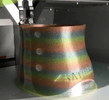
3D Printed Scoliosis Braces: Why the Helios Ortho Is Transforming Digital Orthotics
, by E-com Digit, 6 min reading time
, by E-com Digit, 6 min reading time
When it comes to producing spinal braces—or back braces—with precision, comfort, and customization, traditional methods like thermoforming or molding often fall short. Enter the Satres Helios Ortho, a 3D printer engineered to bring orthopedic device manufacturing into the future.
The orthotics and prosthetics industry is undergoing a rapid shift toward digital manufacturing. Technologies such as 3D scanning, computer-aided design and additive manufacturing are redefining how orthotic devices are produced.
One area seeing significant innovation is the fabrication of spinal braces. Scoliosis orthoses require extremely precise geometry to apply corrective forces while remaining comfortable for long-term wear.
New high-temperature medical printers such as the Satres Helios Ortho are enabling orthotic laboratories to manufacture spinal braces using fully digital workflows.
For decades, spinal braces have been produced using plaster casting and thermoforming techniques. While these methods are proven, they present several challenges.
Traditional brace production often involves:
plaster torso casting
manual modifications of molds
vacuum forming plastic over a carved model
multiple adjustment sessions
These steps are labour intensive and difficult to standardise across clinics.
Digital fabrication offers an alternative approach that reduces manual steps and improves repeatability.
A digital orthotic workflow begins with capturing the patient’s anatomy using a 3D scanner. The scan data is then modified in specialised CAD software before manufacturing.
The workflow typically includes:
3D scanning of the patient’s torso
digital rectification and brace design
additive manufacturing or CNC carving
post-processing and clinical fitting
Digital workflows allow clinicians to store and compare patient data over time. This can be valuable for monitoring scoliosis progression.
Precision is critical in scoliosis brace design. Even small deviations in brace geometry can affect correction forces and patient comfort.
The Helios Ortho is capable of printing at resolutions down to 50 microns, allowing extremely detailed anatomical reproduction.
This level of precision helps orthotists create braces that:
closely follow patient anatomy
reduce pressure points
improve comfort during daily wear
Improved comfort is strongly linked to patient compliance, which remains one of the biggest challenges in scoliosis treatment.
One major barrier to 3D printed orthoses has been printer size. Many industrial printers cannot accommodate large orthotic shells.
The Helios Ortho addresses this challenge with a 600 × 600 × 600 mm build volume.
This large print area allows laboratories to manufacture:
full scoliosis brace shells
large spinal orthoses
cylindrical support structures
Printing a brace in one piece reduces assembly complexity and improves structural integrity.
Spinal braces must be both strong and lightweight. Modern 3D printers can now process advanced engineering polymers designed for demanding medical applications.
Materials supported by high-temperature printers include:
PEEK
carbon-reinforced nylon
medical nylon blends
Ultem
These materials provide excellent strength-to-weight ratios and long-term fatigue resistance.
Material selection also allows orthotists to tune the brace stiffness depending on the patient’s condition and correction requirements.
High-performance polymers require stable thermal conditions during printing.
The Helios Ortho includes a heated build chamber capable of reaching 120°C. This reduces warping and improves layer adhesion.
Additional integrated features include:
filament drying systems
HEPA air filtration
enclosed thermal control
These systems help maintain consistent print quality for large orthotic parts.
Producing spinal braces using additive manufacturing often involves long print cycles.
To support clinical production, the Helios Ortho includes several reliability features:
remote monitoring via computer or smartphone
power-failure recovery
automated filament management
These tools allow technicians to monitor production while continuing other workshop tasks.
A modern digital orthotics workflow might look like this:
Patient scanning
A handheld scanner captures a precise digital model of the patient’s torso.
Digital design
The orthotist modifies the brace geometry using CAD software to create correction zones and relief areas.
Material selection
Engineering polymers are chosen based on strength, flexibility and patient comfort.
3D printing
The brace is printed on a large-format printer using optimised layer settings.
Post-processing
Supports are removed and surfaces are finished before fitting.
Clinical fitting
The brace is fitted to the patient. Minor design adjustments can be printed quickly if required.
This iterative workflow allows faster optimisation than traditional fabrication methods.
Some clinicians remain cautious about additive manufacturing in orthotics.
Common concerns include surface finish, device strength and regulatory compliance.
These challenges can be addressed through design strategies.
For example:
internal lattice structures can reduce weight
surface smoothing can improve patient comfort
traceable materials support clinical compliance
As additive manufacturing technologies mature, these concerns are becoming easier to manage.
Digital fabrication is likely to play an increasing role in orthotic manufacturing over the next decade.
Emerging technologies may include:
parametric brace design based on patient data
AI-assisted orthotic modelling
finite-element analysis for mechanical optimisation
advanced composite printing materials
These developments could dramatically improve orthotic personalisation and clinical outcomes.
For orthotic laboratories across the Middle East, Africa and South Asia, digital manufacturing offers an opportunity to strengthen local production capacity.
By adopting scanning, CAD and additive manufacturing technologies, clinics can reduce reliance on imported devices while improving turnaround times for patients.
As digital orthotics continues to evolve, platforms such as the Helios Ortho demonstrate how modern manufacturing can reshape orthotic care worldwide.

Digital orthotics can dramatically reduce the hidden costs of manual grinding, including technician time, material waste, inconsistent output and limited production capacity. This article explores...

The rise of smartphone scanning and 3D printing for custom insoles poses challenges for O&P clinics, highlighting the need for modernization in patient care.

Explore the balance between digital innovation and manual skills in prosthetics and orthotics,