
Smarter Insoles: Variable Stiffness Through 3D Printing — Without Workflow Complexity
, by Hugh Sheridan, 4 min reading time
, by Hugh Sheridan, 4 min reading time
For decades, orthotic insole fabrication has relied on material selection and manual modification to influence stiffness and support. EVA durometers, layered builds, posting strategies and milling techniques have all played their part.
But what if stiffness could be tuned not by changing material — but by changing structure?
With modern additive manufacturing, clinicians and technicians can now produce insoles with precisely controlled stiffness profiles, all from a single material platform. The real breakthrough is not just in what is possible — but in how simple it has become to implement.
In 3D-printed insoles, stiffness is controlled by internal lattice density and geometry.
Denser internal structures produce greater stiffness and energy return
More open lattice patterns create flexibility and shock absorption
Structural transitions can be smoothly graded across zones
Instead of relying solely on material hardness, the mechanical behaviour is engineered through internal architecture. This allows for far more refined control than traditional milling from homogeneous blocks.
One of the historical barriers to advanced orthotic design has been complexity. Specifying densities, manually adjusting zones, or reworking CAD models can slow production and increase variability.
Modern intelligent design software now removes this burden.
Rather than defining technical density values, clinicians simply select the desired stiffness profile, and the software automatically generates the optimal internal lattice configuration. The workflow remains streamlined:
Scan or capture patient data
Define clinical objectives
Select stiffness preferences
The system handles the structural engineering behind the scenes.
Because stiffness is structure-driven, insoles can now offer element-specific responses within a single device:
Firmer medial arch zones
Controlled forefoot flexibility
Enhanced heel energy absorption
Targeted metatarsal offloading
These variations can be smoothly integrated without abrupt material transitions. The result is a more biomechanically responsive orthotic that aligns closely with patient-specific pathology and gait characteristics.
Traditional milling methods require:
Switching materials
Laminating layers
Bonding components
Managing inventory of multiple durometers
With 3D printing, a single material can deliver multiple performance characteristics simply by altering internal geometry. This reduces material complexity while expanding design capability.
In effect, structure becomes the variable — not the polymer.
For clinics and labs across the IMEA region, this approach offers several practical advantages:
Reduced inventory complexity
Faster customisation
Repeatable digital workflows
Scalable production
High patient satisfaction through improved comfort and performance
Perhaps most importantly, it enables precision without adding operational friction.
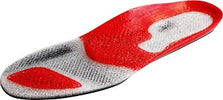
When viewed without top or bottom cover layers, the internal lattices of 3D-printed insoles reveal the sophistication of the design. The varying densities, geometric transitions and load-bearing zones illustrate how modern additive manufacturing is transforming what was once a uniform block into a dynamic biomechanical system.
The evolution of insoles is no longer about carving shape alone — it is about engineering performance at a structural level.
3D printing is not just an alternative manufacturing method. It is a fundamentally different way of thinking about orthotic design — one that combines precision, efficiency and performance in a single streamlined workflow.
For forward-thinking O&P providers, the opportunity is clear: deliver smarter insoles without making production more complicated.

Digital orthotics can dramatically reduce the hidden costs of manual grinding, including technician time, material waste, inconsistent output and limited production capacity. This article explores...

The rise of smartphone scanning and 3D printing for custom insoles poses challenges for O&P clinics, highlighting the need for modernization in patient care.

Explore the balance between digital innovation and manual skills in prosthetics and orthotics,