
The Hidden Cost of Manual Grinding in Orthotics Labs — and How Digital Production Can Change the Equation
, by Hugh Sheridan, 8 min reading time
, by Hugh Sheridan, 8 min reading time
Digital orthotics can dramatically reduce the hidden costs of manual grinding, including technician time, material waste, inconsistent output and limited production capacity. This article explores how Qaadir technologies such as 3D foot scanning, pressure analysis, Voxelcare CAD, CNC milling and automated 3D printing can help orthotics labs build a more efficient, scalable and repeatable production workflow.
Custom foot orthotics are still frequently produced using fabrication processes that depend heavily on technician time.
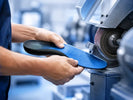
Casting or scanning may be relatively quick. Prescription may be straightforward. But once production begins, many laboratories still depend on milling, grinding, shaping, buffing and finishing each individual orthosis by hand.
For a clinic making a handful of devices each week, this may appear manageable.
As volumes increase, however, manual production can become one of the biggest constraints on growth.
The important question for O&P clinics is therefore no longer simply:
How much does it cost to manufacture an orthotic?
It is:
How much is manual production costing the business in technician time, material waste, production capacity and scalability?
Grinding and finishing are often treated as unavoidable workshop activities.
The real cost extends considerably further.
Traditional CNC manufacturing of EVA orthotics is subtractive. A larger EVA block is milled until the required orthotic geometry remains, meaning a proportion of the original material inevitably becomes waste.
Manual grinding and finishing can remove further material.
As production volume increases, this waste scales alongside it.
This does not mean milling is obsolete. Milling remains an extremely effective and established manufacturing method for orthotics.
But laboratories should understand the complete cost of the process rather than looking only at the purchase price of the EVA block.
One of the most valuable resources in an O&P laboratory is not a machine.
It is an experienced technician.
Grinding, shaping and finishing orthotics requires skill, judgement and time. When production increases, the traditional solution is often to add technicians or increase workshop hours.
Eventually the relationship becomes straightforward:
more orthotics = more technician hours.
This creates a natural ceiling on production.
Digital manufacturing changes that relationship.
Qaadir's approach to digital orthotics is therefore based around connecting the complete workflow rather than focusing on a single production technology.
Production efficiency begins before the orthotic reaches the workshop.
Modern pressure and gait analysis systems allow clinicians to capture objective information about plantar loading, weight distribution and gait rather than relying exclusively on visual assessment.
Qaadir offers pressure and gait analysis technologies that can be integrated into clinical orthotic assessment, particularly for areas such as diabetic foot management, sports biomechanics and custom foot orthotics.
The Qaadir Da'at Wireless Pressure Plate System, together with solutions from Voxelcare, enables clinics to incorporate digital plantar-pressure information into their assessment workflow.
The objective is simple:
capture better clinical information before manufacturing begins.
Scanning provides the second part of the workflow.
Systems such as the Qaadir iQube View 3D Foot Scanning System allow clinicians to capture a true-scale digital representation of the patient's foot without relying on traditional plaster or foam-box processes.
The iQube View uses infrared structured-light scanning and can capture multiple foot measurements while generating a 3D model.
Other options available through Qaadir include Voxelcare foot scanning technologies, Structure Sensor 3 and other portable 3D scanning systems.
Once accurate digital anatomy has been captured, that data can flow directly toward orthotic design and production rather than requiring physical casts to be transported, stored and manually modified.
The next major opportunity for laboratories is digital design.
The Voxelcare Orthotics CAD Designer, available through Qaadir, is specifically designed for custom foot orthotics rather than being a general-purpose engineering CAD platform.
Clinicians and technicians can digitally apply corrections and design characteristics while maintaining a patient-specific digital file.
This introduces an important advantage over purely manual fabrication:
repeatability.
If a patient needs another pair in six months, the clinic does not necessarily need to recreate the entire device manually.
The digital prescription and geometry can provide a consistent starting point for repeat manufacture.
It can also make multi-site working easier because digital cases can move between clinics, designers and central fabrication facilities without transporting physical casts.
Digital transformation does not automatically mean replacing CNC milling.
For many clinics, EVA remains the preferred orthotic material.
A digitally scanned and CAD-designed orthotic can therefore be manufactured through a modern CNC milling workflow using appropriately selected EVA blocks.
Qaadir supplies Voxelcare EVA and Combi Line EVA blocks, including materials combining different densities to provide support and cushioning within the finished orthosis.
The advantage is that scanning, digital prescription and CAD can improve the workflow leading into the milling process.
However, laboratories still need to account for machine time, EVA waste and subsequent finishing.
That is where additive manufacturing becomes increasingly interesting.
Instead of removing material from a larger block, additive manufacturing builds the orthotic from digital geometry.
For orthotic laboratories, the attraction is not simply that 3D printing is a newer technology.
The opportunity is automation.
Voxelcare's digital orthotics ecosystem includes both filament and pellet-based printing technologies, while its newer 3D Printer Automation Module is designed to reduce operator intervention during higher-volume production.
The system supports automated unloading and longer continuous production cycles, with Voxelcare positioning the technology around improved uptime, output and consistency.
This matters because a printer that constantly requires someone to remove parts and restart jobs can simply create another labour bottleneck.
Automation changes the economics.
A laboratory can potentially move toward:
Scan → Analyse → Design → Print → Finish → Fit
rather than a workflow dominated by manual material removal.
It would be unrealistic to suggest that digital fabrication eliminates technicians.
It does not.
There will still be requirements for:
The real opportunity is to stop using highly skilled technicians for repetitive activities that technology can increasingly perform.
That frees those technicians to concentrate on tasks where experience actually adds value.
Manual craftsmanship remains extremely important in O&P.
But high-volume manufacturing also requires repeatability.
Digital scanning, CAD and automated manufacturing allow laboratories to create a documented production workflow where the same digital design can be manufactured again without starting from zero.
For larger orthotic providers, hospital networks and multi-site podiatry groups, that consistency can become particularly valuable.
A clinic in one location can assess and scan the patient.
A designer can modify the device digitally.
A central fabrication facility can manufacture it.
The finished orthosis can then return to the clinic for fitting.
That separation between clinical care and physical manufacturing creates entirely new operating models for O&P businesses.
For clinics considering investment in digital orthotics, comparing the purchase price of a scanner, CAD system, mill or printer tells only part of the story.
The better calculation is:
How many additional orthotics can the clinic produce without proportionally increasing labour?
That calculation should include:
Once those factors are considered, the economics of automation can look very different.
The orthotics market is moving from individual pieces of equipment toward connected digital production.
Qaadir's portfolio allows clinics to build that workflow progressively rather than committing immediately to one manufacturing philosophy.
A clinic could begin with pressure analysis and 3D scanning.
Then add Voxelcare CAD.
Production could initially remain CNC-milled EVA.
As volume increases, the business could then introduce 3D printing and automated production.
That gives clinics a path toward digitalisation without requiring them to abandon proven clinical or manufacturing techniques overnight.
The objective should not be technology for technology's sake.
It should be to create a production system that allows clinicians and technicians to serve more patients, produce devices more consistently and make better use of increasingly scarce skilled workshop labour.
For orthotics laboratories across the IMEA region, that may become one of the most important commercial arguments for digital manufacturing.
The future of orthotic production is unlikely to be entirely manual or entirely automated.
It will be about deciding which parts of the workflow genuinely require human expertise — and allowing technology to handle more of everything else.

Digital orthotics can dramatically reduce the hidden costs of manual grinding, including technician time, material waste, inconsistent output and limited production capacity. This article explores...

The rise of smartphone scanning and 3D printing for custom insoles poses challenges for O&P clinics, highlighting the need for modernization in patient care.

Explore the balance between digital innovation and manual skills in prosthetics and orthotics,